Pazur
Pazur is a modern digital identity and health management app for pets, designed to simplify communication between pet owners and veterinarians. The platform centralizes medical records, vaccinations, passport details, illnesses, and chip information in one intuitive ecosystem inspired by digital citizen apps.
Mobile App
Behind the Screens
Role: UX/UI Designer (solo project)
Type: Mobile & Web App
Year: 2026
Tools: Figma, Superdesign, Claude
Overview
Pazur is a digital health management platform for pets that centralizes medical records, vaccination history, chip data, and veterinary documentation in one place. The platform is designed for two distinct user groups - pet owners and veterinary clinics. The owner-facing panel is complete; the veterinary clinic panel is currently in progress.
The Problem
Poland has no centralized, accessible system for pet health documentation. Records are scattered across vet clinics, paper health booklets, microchip databases, and private registries. This creates real friction in everyday situations and puts animals at risk in critical ones.
Key pain points identified through desk research:
Pet owners have no single source of truth for their animal's health history
Veterinarians seeing a new patient often have zero context on prior treatments
Transferring ownership, traveling internationally, or responding to an emergency requires gathering documents from multiple sources
The upcoming CRPiK regulation (mandatory pet registration in Poland) would create a legal need for a compliant digital system
The core insight: when a pet ends up at an unfamiliar vet in an emergency, the absence of records isn't just inconvenient, it's dangerous.
Research & Discovery
Given the nature of this project (product concept + pitch deck), the research phase focused on desk research, competitive analysis, and regulatory context rather than primary user interviews.
What I explored:
Regulatory landscape - The CRPiK Act (2025) mandating the registration of dogs and cats in Poland creates a direct integration opportunity and a market entry window.
Competitive landscape - Existing pet health apps (PetDesk, VitusVet, Vet24) are fragmented and mostly focused on appointment booking, not documentation. None address the multi-role ecosystem (owner + vet) holistically.
Analogous systems - I looked at digital health identity models like mObywatel, eHealth patient portals, and EU digital vaccination records as design references for trusted, government-adjacent health products.
User groups mapped - Two primary user types emerged with fundamentally different needs and mental models: pet owners (personal, emotional connection, ease of access) and veterinarians (clinical efficiency, speed, professional reliability).
Define
How might we give every pet a reliable, portable health identity - accessible to both owners and vets, that reduces friction in routine care and eliminates critical information gaps in emergencies?
Key Design Challenges
1. Multi-role information architecture
Pazur needed to serve two very different user types within one product ecosystem. An owner looking at their dog's profile and a vet checking the same record have completely different goals, mental models, and contexts. The system had to be role-aware from the ground up, not just in terms of permissions, but in terms of what information is surfaced, how it's labeled, and what actions are prioritized.
2. UX in emergency and high-stakes situations
A core use case I focused on was the emergency visit scenario: a pet is brought to an unfamiliar clinic, the owner is stressed, and the vet needs to act fast. This is the highest-stakes moment in the product's use. It shaped several fundamental decisions from how quickly a vet can look up a patient by chip number, to what information appears first in the health summary.
Design Process
Information Architecture
I began by mapping out the full IA for both panels before touching any UI, establishing the complete system architecture upfront, even though the visual design is being built in stages.
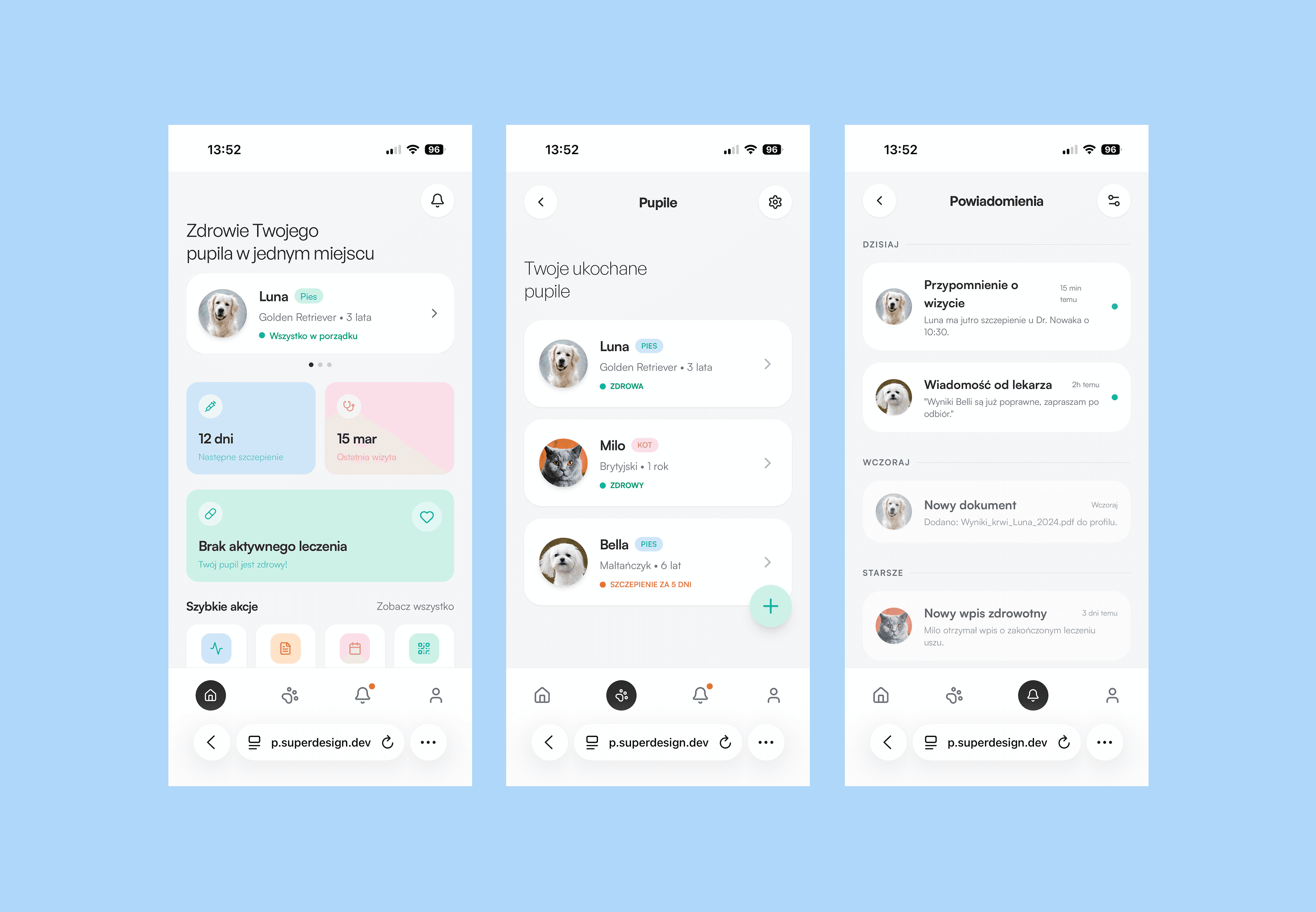
Owner panel (designed) centers around the pet profile as the core object. The full panel spans 13 screens: onboarding via Login and Registration, a Dashboard with health status at a glance, Pet List and Pet Profile for managing individual animals, Health History and Health Entry Details for medical records, Documents and Document Preview for attached files, Appointments for visit tracking, Notifications for reminders and vet messages, Sharing & Permissions for access control, and User Profile for account settings. Vaccination timelines, health history, and upcoming reminders all radiate from the pet profile as the central object. The owner also controls the permission layer: granting temporary access to vets, which is key for the privacy model.
Vet panel (currently in progress) is planned around search and triage. The dashboard will show today's patients at a glance, with quick-lookup by chip or passport number as the most critical entry point, designed for one-handed use in a clinic setting.
Both panels share the same underlying data layer, but surface it through completely different navigational logic.
Emergency Flow Prioritization
The emergency vet flow became a design anchor - a moment where I made deliberate trade-offs. I prioritized:
Speed of access over completeness - The patient overview shows allergies, chronic conditions, and last vaccinations first, not the full chronological history.
Zero-friction chip lookup - A dedicated search bar is always visible in the vet dashboard, not buried in navigation.
Progressive disclosure - Full documentation is one tap deeper, but the critical summary is always upfront.
Permission & Trust Architecture
Data in Pazur belongs to the owner, but is contributed by vets. This creates a trust model that needed clear UX expression:
Owners grant time-limited access to individual clinics
Vets can add entries but not delete or modify owner-entered data
Access history is visible to the owner at all times
This model was inspired by patterns in e-health systems, where patient agency over their own data is both legally required and a key trust driver.
Visual Language
The visual system was designed to feel calm and clinical without being cold. Medical products often default to either overly sterile interfaces or overly "cute" pet app aesthetics. Pazur sits between: clean typographic hierarchy, muted color palette, clear iconography, approachable enough for a worried pet owner, professional enough for a veterinary context.
Key Design Decisions
Chip number as primary identifier
Rather than building around account-based lookup, the chip number acts as the universal identifier. This aligns with how vets already work and enables access even if the owner is unavailable.
Role-separated dashboards, shared data
Rather than a single app with permission levels, the owner and vet experiences are separate entry points with distinct navigation logic but they pull from the same data model. This prevents both personas from feeling like a secondary use case.
CRPiK integration as a trust signal
Even before the API integration is available, CRPiK status is visible in the pet profile. This signals compliance and legitimacy, especially important for a product dealing with regulated data.
Emergency summary as a distinct component
The health overview isn't just a list of records. It's a specifically designed component that surfaces the most clinically relevant data at a glance, designed for high-stress, time-sensitive reading.
Outcomes
Complete UX/UI for the owner panel - 13 screens covering the full user journey: Login, Registration, Dashboard, Pet Profile, Pet List, Health History, Health Entry Details, Documents, Document Preview, Appointments, Notifications, Sharing & Permissions, and User Profile
Full information architecture defined for both panels, including the vet-facing interface currently in design
Mobile-first flows with web parity
Pitch deck and product brief developed in parallel, making the project dual-purpose: portfolio piece and investor-ready concept
Design aligns with upcoming CRPiK regulatory requirements, positioning Pazur for a real go-to-market opportunity
Reflection
Pazur pushed me to think at a systems level rather than just screen level. Designing for two roles within one product ecosystem, each with different urgency, context, and information needs, required a strong architectural foundation before any UI decisions could be made.
The emergency use case was a particularly useful design constraint. It forced clarity: when everything can't be first, you have to decide what matters most. That kind of prioritization thinking is something I want to carry into every project.
The next step is completing the veterinary panel with a particular focus on the quick-lookup and patient summary flows, where even small friction has outsized consequences in a clinical context.
It's the kind of project that reminded me why systems thinking and emotional design aren't opposites - they're the same thing.